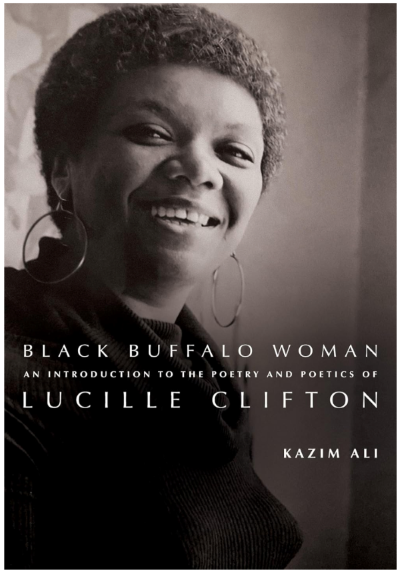
I wasn’t satisfied with this book, even though its author is well-informed, and I am strongly interested in its subject, Lucille Clifton. Like Kazim Ali, I have read and reread all of Clifton’s books, including her many children’s books. And I find her very worth talking about. But, from my perspective, Kazim Ali approaches Clifton far too reverentially. His admiration pretty much knows no bounds, and—as often happens in such cases—this does not sharpen the writer’s critical apparatus.
I’ve pointed this out before, in connection to many people who care about Clifton. Their Clifton is serene and wise and infinitely grateful. She has the Right Attitude towards the universe: Awe. She has the right attitude toward everything, for she is a holy person.
Granted, the above is how Clifton herself wanted to come off. For years and years, when she signed books, she wrote “Joy!” and then her name. It appears that neither she nor anyone participating in the online discourse surrounding her imagines that, if she actually answered the above description, she would not be anywhere near as interesting as she is, nor as powerful. She would be Coleman Barks’ Rumi.
My Lucille Clifton had two qualities that are not much to-the-purpose if one is trying to come off like a sage, but are really good if a poet wishes to exercise personal fascination: (1) lack of boundaries, (2) extreme willingness to self-contradict. Especially for a person who traffics in epigrams as Clifton did, quality #2 there conduces to coming off engaging and authentic.
See, a big part of Clifton’s project was vindication. Vindication of herself, her family, and Black Americans. However, a very important part of her knew that all things under the sun are hopelessly compromised and cannot be vindicated.
Very vivid example, not pleasant: Lucille Clifton was sexually abused at some length by her father in her childhood; her mother probably knew, and did nothing. Clifton mythologized these parents (and her other ancestors) in her 1976 memoir Generations with all of her vindicating powers at full thrust. It’s a good book. But, twenty years later, she revealed in her poems what she had withheld in the memoir—to electrifying effect.
Clifton knew there were tensions between many of her writings. She let those tensions stand. Almost all her pieces were, after all, weather reports on the state of her soul, that day. And naturally the weather “contradicts” itself…
See, I am not here describing a poet of joy, gratitude, serene wisdom. Sometimes she is ready for brotherhood of the races, peace and love. But sometimes she’s ready to say white is the way of Death, and Black is the true Dao:
only to keep
his little fear
he kills his cities
and his trees
even his children oh
people
white ways are
the way of death
come into the
black
and live
Sometimes she’s down for forgiveness; other times she’s quite content to “sit with” the prospect of feeling permanent contempt. I want to say explicitly: To me, this is why she’s good. To many who revere her, though, the not-nice feelings and attitudes have to be explained away, “contextualized.” Her true position was “Joy!”
That is Ali’s book, in my opinion. He walks you through fifty or sixty poems, one at a time, translating them into their abstract meanings, giving the equivalent of footnotes where there is small need of footnotes. Any four pages, taken together, will read like somebody’s mid-term paper. This is fatiguing—especially if you don’t stand in need of explanations like:
As we have seen in both the penultimate line of this poem and in Willie B.’s second poem in the “buffalo war” sequence, the term “gone” has two meanings: it is an adjective in Standard English meaning ‘absent,’ but in African American Vernacular/Black English, it is also a form of the transitive future tense, i.e. an oral elision of the construction “going to.” In other words, “who gone remember” here means “who is going to remember,” (though Black English/AAVE typically eliminates/elides “to be” as a helping verb in present participial form) so the mourning line “Langston gone” does mean ‘Langston is gone,’ i.e. dead, but it also means “Langston is going to.” Clifton not only mourns Hughes’ passing, but affirms the continued presence of his spirit and the continued and continuing relevance of his work.
But it’s worse than fatiguing to listen to all these poems being discussed without the commentator’s resisting anything that she’s saying. Example. There’s a poem where Clifton has her thumbs-up character call the thumbs-down character a “faggot”—
richard penniman
when his mama and daddy died
put on an apron and long pants
and raised up twelve brothers and sisters
when a whitey asked one of his brothers one time
is little richard a man (or what?)
he replied in perfect understanding
you bet your faggot ass
he is
you bet your dying ass.
That’s the whole poem. I thought: Well for sure KA will be, I dunno, saddened by that usage. He’ll at least be uneasy. Not a bit of it:
Here, Little Richard’s act of raising his siblings qualifies him as a “man” more than any gender-based behavior or sexuality would. The brother has a “perfect understanding” of both what the interviewer is implying and of Little Richard’s nature as a “man.” When he replies to the interviewer, calling him a “faggot ass,” he turns the interviewer’s assumptions and behavior back around on him, i.e. it is the interviewer who has acted “unmanly” in posing the question at all. The term, which must have been used against Richard at some point, turns into a badge of honor.
This is what I mean by “reverence seldom sharpens.” The word faggot obviously does not turn into a badge of honor. But there it is. Reverence explains away. Reverence finds no fault with its teacher.
And then there is the book’s last bit:
Here, at the end of the book, is what I believe: Lucille Clifton was one of the greatest poets of the twentieth and twenty-first centuries and one of the greatest in the English language. She is equal to Dickinson or Auden or Whitman or Brooks. Her body of work is timeless, and essential part of American literature.
Look what little distance we have come. 2026, and we still think this is how to praise a poet. Most people do not see how vanishingly little is accomplished by accepting the old index of value and “greatness”—Harold Bloom’s list of who’s in and who’s out. Would it not be much better to say “You can get from Clifton what’s hard to get elsewhere. A whole person: not a half, not a quarter. Storm, sunshine; right, wrong; love, hate—all of it expressed memorably.” But, see, to say that, you would have to treat her not like a shaman or a guru, or your mother or your best friend. You would have to treat her like she was a fellow wilted human being. A better writer than you, OK, but why not just say “We read her over and over.” Why must we pretend she had no faults? Half the time, it’s her faults that make us read her over and over!
❂
ANTHONY MADRID lives in Victoria, Texas. His writing has appeared in Best American Poetry, Boston Review, CONJUNCTIONS, FENCE, Georgia Review, Harvard Review, Lana Turner, LIT, and Poetry. He is the author of three books, all from Canarium: I Am Your Slave Now Do What I Say (2012), Try Never (2017), and Whatever’s Forbidden the Wise (2023).